Header

Header

Pages

Showing posts with label connecting to readers. Show all posts

Monday, July 7, 2014

Marketing Mondays: What's in a Blog?

Marketing Mondays is here again! For those of you just tuning in, we've covered author brands, Facebook, and the rest of the social media world. Today I'm going to blog about blogging. Mind blowing, right?

So what's in a blog? Well, that depends on who you are and what you want to write about. You don't always have to write about writing. Sure, you can write about that. But I'm sure there's more to you than being a writer. Maybe you like to get crafty or love to workout. Are you aiming to be on the next Top Chef or just like to cook like you might? Maybe you're a super fangirl and want to squee about the latest episode of Teen Wolf or shake your fist about Agents of S.H.I.E.L.D.
WHEDON!!!
Image from DNAIndia
Whatever you choose to write about, let it be something that means something to you. I'm writing about marketing right now because it is a very big part of what I'm doing with my books right now, and something I am thrilled to still be learning about and expanding on. But I'm also writing about my journey to become physically fit, and I post blog tour stops and book reviews. Sometimes I participate in blog hops too, but we'll get to those later.

What should I write?
For now, let's focus on what you can write about and how often you should do it. I'd suggest making a list of the things you are interested in and deciding what you'd like to write about from there. Keep in mind that your posts don't have to be long, and try to be yourself as much as possible. In my opinion, the whole point of blogging as a writer is for people to get to know you and your voice. So don't be afraid to let the snark out, and if you think something is clever, then say it. Even if you think you're the only one snarfing at your jokes, make them. Because why not? It's your blog. Be you!

Just like with social media, you have to strike a balance. You don't need to blog every day or even every week. Writing up a blog can take time, and for a lot of authors, time to write is precious and you might not want to spend all of it blogging. I have two weekly features on my blog--my fitness challenge and Marketing Mondays. But that's because those two topics work well for a weekly blog. If you are blogging about new knitting designs you are working on, it might be more of a once a month or once every other month (Can you tell I don't knit anything more complicated than scarves?) kind of topic. New recipe? That could be every week, every other week, every month--whatever you choose. Don't let it get overwhelming and don't try juggling too many topics per week. I actually had to cut down on the amount of blog tours I host for this reason. Blogging was taking up too much time, and none of it was personal. Balance in all things, right?

Which brings me to the topic of blog tours and book reviews. First, let me say that I love hosting blog tours and reviewing books. I love it so much that I have a really hard time saying no when asked (please don't test this). I'm a lot more choosy now with books that I review or blog tours that I host stops for simply because I don't want my blog getting overrun by blog tours and because there aren't enough hours in the day for me to get through my To Be Read list as it is.
So many books, so little time...
Image from Drugs Called Books
What about blog tours?
First, you might be asking what a blog tour even is. When I first started out in the writerly world, I had no clue. The basic gist of a blog tour is that it is essentially a virtual book tour, where an author goes from blog to blog promoting their books and their work. There are different kinds of posts for tours, like author interviews, character interviews, guest posts where the author discusses a topic of their choosing or yours, review stops, excerpts, and promotional stops that simply have the cover, blurb, purchase links, and author info. Tours can last anywhere from a week to a month. I've never seen one longer than a month, but I guess it's possible. AToMR book tours actually has a great post about what blog tours are, and you can check that out here.

So how do you get involved with blog tours? Some tour companies might have criteria such as having a certain number of followers first, but others don't. Your best bet is to run a search for blog tours or blog tour companies and go through the list, picking out ones that seem like a good fit. You don't exactly want to sign up for a romance blog tour company if romance isn't even a genre that you read (Yes, I did that). I host for Bewitching Book Tours, and I can vouch for how excellent Roxanne is at running things. I've hosted for other companies before and it's been a bit chaotic, but Roxanne is very organized and gets everything to you in a timely manner. If Bewitching Book Tours doesn't look like a good fit for you, there are lots of others you can check out. I already mentioned AToMR, but there's also Xpresso Book Tours, Book Sniffer Review Tours, and New Adult Blog Tours just to name a few.

What's a blog hop?
Blog hops are themed blog posts, essentially. A group of bloggers all write about the same topic and link to the other bloggers posting about the same thing. It can be something like My Writing Process, Introduce Your Main Character, or What's Up Wednesdays, where you post about what you've been up to that week. I've also seen blog hops in the form of blog awards like The Next Big Thing and the Liebster Award, which are set up to have the blogger answer the same questions, thus giving the readers some insight into who the writer is.

So basically...
When deciding what you want to blog about, don't overbook yourself. If you want to do What's Up Wednesdays, don't feel like you have to join in every Wednesday. Especially if you don't have anything new to catch your readers up on. If you want to have a weekly feature, like a blog promotion or specific topic (like talking about marketing every Monday even if you feel like you've barely scratched the surface of what's out there...*ahem*), don't book blog tour stops for every other day of the week. And keep in mind that just because you want to blog about a topic doesn't mean it needs to be a weekly or monthly feature. It can just be a one-off type thing, or something you do when the topic comes up again (like new recipes). Having a feature is a great way to get people coming back to your blog to look for content, but it isn't a sure-fire way to gain followers, and it certainly isn't the only way either. In fact, I'd recommend that you don't even pay attention to how many followers you have because that's a good way to add pressure to something that should be easy and stress-free.

There are many things that you can do with your blog--some things you can do might not have even occurred to me. Get creative. Have fun with it. The point of a blog is to get to know you. And not to overwhelm you, which is the most important thing to keep in mind with all of these marketing tips and tools. They are just that--tools meant to help you, not to hurt you.

Next week is the cover reveal for Soulless by Crystal Collier, and then we'll be back for Marketing Mondays to talk about Facebook and Twitter parties and giveaways.

Monday, June 30, 2014

Marketing Mondays: Using Social Media Effectively Without Getting Overwhelmed

Welcome back to Marketing Mondays! So far we've covered Author Brands and that big old social media giant called Facebook. Today I'd like to move beyond Facebook to discover every other version of social media there is. 
Image from business2community
Brace yourselves--there are enough social media platforms out there to eat up your entire day if you let them. But we aren't going to let them! I'm going to share my experiences with each one, and then talk about how to use them without getting overwhelmed. And for the record, we're not going to be looking at every form of social media. There are way too many (and if you don't believe me, check out this list on Wikipedia) for me to try each one. 

Twitter
You've most likely heard of this one. And if you aren't very active in the social media world, then you might have gone running and screaming from the fast moving feed and 140 character limit. I sure did. I would only get on Twitter when I had something short to say, like announcing something to do with my books or a link to a blog post or something. 

I've recently changed my tune with Twitter, and I'm glad I did. This is a great place to hang out with other writers. Oh, and celebs are funny. It's a great place to get involved in writing sprints and literature chats. I've been involved with #NALitChat on Thursday nights for a while now, and it's been a great resource and a great way to build connections. The 140 character limit can be a pain, but once you get the hang on Twitter speak, it isn't that bad. 

Google+
Google Plus started off pretty weak, and most people didn't see much of a point to it (myself included). 
Not exactly accurate anymore, but still funny.
Image from tech.digesttouch
But it is quickly growing into one of the better social media platforms, especially with the new addition of Communities. Communities allow you to join up with other groups of people who have common interests, like fans of a particular television show or book clubs. 

There are also some major perks to posting on Google+ that have to do with search engines, but I'm not entirely sure I understand it all. I do know that if you have me in your circles and search for something I've recently posted about (like Boy Meets World) in Google, my post will show up in your search results. That's pretty cool! 

Tumblr
My experience on Tumblr is very limited, but can be summed up to this:
Image from Erin
Fangirls! Fangirls everywhere! Which means I fit in all too well. It's not a site I visit often, and not just because I can seriously waste a lot of time there. And I'm not even a Supernatural fan (but pretty sure everyone who is a fan of the show hangs out there). There are memes, gifs, videos...You can create a page about your books and post stuff there, or just join with other fans to post fun stuff about your favorite fandoms. It's fun!

Pinterest
Talk about a place where you can get lost for hours...Pinterest is definitely a site you have to be careful with. If you like DIY stuff, baking, fashion, or ANYTHING at all, you can spend lots of time on Pinterest. It's not exactly a place I've found to be very social, but it is a great place to find things you are interested in and...pin them. It's also a useful tool for authors to create boards about their books. I've got one for character inspirations ("casting" actors), scene inspirations, and even a board that was "created" by the main character Madeline in my book Altar of Reality. This is a great way for readers to further connect with your books. 

YouTube
YouTube didn't used to be a form of social media in my book, but with all the vlogging going on, it has to be included. I might even give vlogging a shot myself at some point. YouTube has beyond making fan music videos (guilty) to reviewing books, movies, and TV show episodes. Like this brilliant fan reaction moment to a certain Oliver and Felicity moment from the season 2 finale: 
People can comment on YouTube videos, which creates the social part of social media. And as you can tell from the options I mentioned above, you can do creative things with your channel beyond vlogs. I created a playlist for each of my book series with music videos from the soundtracks, and I also have my book trailer up on there.

Goodreads
If you are an author, you need to at least establish a presence on Goodreads. You can get involved with the groups there, which can get your book more visibility and more reviews. The groups are essentially book clubs in the form of message boards. There are Read It and Review It programs in a lot of them, where authors offer up free copies of their books for members to review. Similarly, book groups choose books to read and review each month as a group, which opens up a lot of discussions. I've seen Q&A's from authors too, though I've never done one. I've offered up Heirs of War for Read It & Review It programs with mixed experience, but I think they are worth a try. 

Image from MuddyWall
I know Goodreads has a bit of a reputation for being the place where bullies or flamers hang out, but I think you risk that with any form of social media. And as long as you have a strict "Don't feed the trolls" policy, you'll probably be okay. I've had random one star or three star ratings for a book that hasn't even come out yet, but I just ignore it.

Wattpad
I've already discussed my Wattpad experience, so I won't go into heavy detail with it here. But I can tell you that I think this is the absolute best social media platform for authors to connect with readers. You post chapters from your books and readers, well, read them, of course. But there's more to it than that. They can post comments, giving you their thoughts on what you wrote or even specific lines that they can highlight. If they follow you, you can post updates to your profile letting them know what is going on. I use mine to let my followers know about things like Facebook parties and giveaways. Oh, and you can also link your profile to your Twitter and Facebook accounts so that whatever updates you post on Wattpad are posted on there as well.

Instagram and LinkedIn are two other popular social media sites, but I'm not involved with either one. As I understand it, LinkedIn is more of a business connections sort of place. Instagram is all about pictures (I think) but I've heard you can post things like memes there too instead of just tons of selfies and pictures of your food. People can like and comment on your photos, which makes it a bit more than just pictures. And again, you can link your Instagram to Twitter (possibly Facebook? I dunno). Now that I am doing things like book signings (EGAD), I think I'll hop on Instagram as well. 

How To Balance Them All
You might think that as a writer, you need to use every form of social media to promote your books and build your author platform. 
Image from business2community
But you really don't. My solution is simple, really. Pick the ones that work for you. I don't get on Tumblr or Goodreads a lot. I'm trying to spend more time on Google+ but it's not an every day thing. I use Pinterest and YouTube when I have a purpose. And I balance that out by spending way too much time on Twitter and Facebook. 

The biggest thing to keep in mind with social media is not to let it get out of hand. Don't spam, and remember that the kind of posts you make are important. Content is key. Your followers don't need to know every time you go to the gym or what your every meal is, but they should probably know a bit more about you than "I has book." If you are writing more words for social media than your books, you should probably rectify that.

With the possible exception of blogging, which is what we will talk about next Monday! 

Monday, June 23, 2014

Marketing Mondays: Connecting to Readers on Facebook

I've already talked about Wattpad and Author Brands as a marketing tools, but now it is time to talk about the massive giant of social media that is Facebook. Let's talk about the good, the bad, and the downright ugly parts of Facebook pages and profiles as an author.

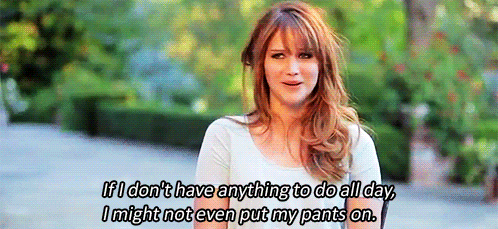
The first and most obvious perk of Facebook is how it allows us to stay connected to our friends, family, and our readers, all without ever having to put any pants on leave the house.
Image from WiffleGif
But when you are using Facebook as a marketing tool, it gets a little tricky to navigate those murky waters. Most of the tips and tricks of the trade on social media have stated that you should have a fan page separate from your Facebook profile for a number of reasons. Let's go over a few:
  1. Facebook does have a cap on how many friends you can have, but there is no limit on how many people can like your page.
  2. You don't necessarily want to share every aspect of your life with complete strangers. 
  3. You want one place for people to be able to go on Facebook to find out about you as an author.
  4. You can advertise your products on your page, but not your profile.
All of these reasons are still relevant. There are ways around them, which I'll get into in a minute. But what is the deal with fan pages, and why can you never see what they post anymore?
  1. With Facebook's new algorithms, it is harder and harder to get your posts seen. What does that mean? It means that if you have 500 followers, your posts might only reach 5. It isn't impossible to be seen (check out this great post on how to improve your page), and it does keep those annoying people who post every five minutes out of your feed, but it has made things significantly harder. 
  2. If you want your posts seen, more people have to like it or comment on it. So if your post reaches only 5 followers who aren't very active on Facebook, or liked you because of some Rafflecopter contest and really have no idea who you are and nothing to say to you, then your only other option for visibility is paying to boost it. And who wants to do that when your post might just be reaching out to your followers to see how their day was?
  3. Photos and videos are more likely to be seen than links or text posts. Don't believe me? Check out this post on Facebook statistics on fan pages. Again, not necessarily a bad thing. But if you are trying to post a link to a blog post you just wrote about social media (*ahem*) then it probably isn't going to be seen by many. Google+ will love it, but we'll get into that later. 
Basically, there are flaws with using either your Facebook profile or you fan page to engage readers. That being said, it still is a GREAT way to engage readers. Let's talk about the pros and cons I've already pointed out. 

Facebook has a cap on how many friends you can have.
Since Facebook now allows people to subscribe to your page, this isn't an issue anymore. As far as I know, there isn't a cap on subscribers, and you should still be able to adjust your privacy settings to where friends can see certain posts (like ones of your family) and specify which specific posts you want the public to see--like ones about your books or general activities. Which brings us to...

Privacy
You can still have a Facebook profile and have privacy. And you don't have to have two profiles to do it. I can tell you from experience that it isn't worth the hassle to have two Facebooks, and let's not forget that Facebook actually frowns on that kinda thing. Last time I checked, you can get banned for it. Not sure how you would get busted, but still. Not worth it anyway. You can adjust your privacy settings on your profile to keep your personal data and photos safe while still being able to share content with the world. The easiest way to do this is to adjust your privacy settings so that all of your posts are set to be viewed only by friends (or people on a certain list), and then when you go to post something you want everyone to be able to see, set that particular post to Public by clicking on the little icon on the bottom right corner of the status dialogue box. 

Easy-peasy. So privacy is no longer an issue as long as you have your default settings set to private. Even if that means creating a list that only has the family and friends you want to view every post and having that as your default. 

You want one place for people to be able to find relevant information about you as an author on Facebook.
Having a profile is okay for this, but having a Facebook page is still probably the best way. You don't want your profile to turn into too much of a marketing tool. The reason why Facebook is a marketing tool is because it helps you connect directly with people who want your product and lets them spread it via word of mouth. And as an author, that is still your bread and butter. So even if you don't post tons on your Facebook page, having it is still a good idea. To me, personally, it is more professional as well. I'm more likely to like an author's page rather than add them as a friend just because everyone has boundaries and you have no idea what the next person's boundaries are going to be. I welcome it, but I don't have kids and I use a pen name. 

Blatant advertising
This is a tricky one. I know Facebook frowns on advertising products or contests from your profile (or they used to, anyway), but you still see it happen. All. The. Time. I also see contests where you have to share links on your Timeline or a friend's Timeline to enter, and that is supposed to be a no-no too. This is what Facebook says about promotions from Pages:
3. Promotions may be administered on Pages or within apps on Facebook. Personal Timelines must not be used to administer promotions (ex: “share on your Timeline to enter” or “share on your friend's Timeline to get additional entries” is not permitted).
That being said, I didn't find anything in the Community Standards that says you can't advertise a product on your Facebook profile. It would probably be way too much of a pain to police anyway. I ran a Google search too, but came up empty. However, I before you do anything like that, I suggest going over the rules yourself. 
So can you advertise on your Facebook profile? Pretty much. But do you want to do that all the time? Probably not. Don't be a spammer. That's a great way to get people to delete you or hide you.

Now let's talk Facebook pages and those pesky algorithms. 
I have been just as likely as the next person to bitch about these. I had my Tumblr linked to bond over fangirl stuff, but I realized those posts weren't being seen. Same thing with Twitter. So I linked stuff that I thought was cool, but those weren't being seen either. Then I read that text based posts were more likely to be seen than links or anything else, so I tried that. But those weren't being seen either. 
Image from PhotoBucket
I've since learned that images and videos are the most likely to show up in someone's newsfeed. Facebook gives those priority. So if you are great with graphics, you can really just post an image saying what you want. I suddenly understand why I've been seeing so many authors using memes to make announcements about their books, too. Clever tricks, and I'm glad to know that now. You still have to jump through the hoops of getting people to like or comment on the image or video, but it's a start. (And as a side note: I've since been trying this and though my posts are being seen by more than 5 people now, I still haven't even reached 10% of those who have liked my page.)

Other tips and tricks to get your posts seen without paying to boost them:
Obviously, having your Twitter linked to your page is a bad idea. Keep the random posts to a minimum and instead post quality content. Don't post every fun link you come across or every funny picture. Engaging your readers doesn't mean spamming them, and the more you spam your Facebook feed, the less likely your posts are to be seen. So keep your posts to a minimum while still trying to engage daily. I've read that liking or saying congratulations will boost a post according to the algorithms, but I haven't seen any data on that. And it feels silly (yes, I tried it). Can't hurt to like your own posts, though. But also make sure you are redirecting your readers there. Let them know you just posted news and get them to go look and like it. Maybe even hold a contest and randomly choose a winner from those who like the post in a 24 hour period. 

The Bottom Line
As you can tell, there's a lot of back and forth in this post about using your profile to connect with readers or just keeping it to a Facebook page. Obviously, you have to find what works for you. But keep this in mind before you let me talk you out of getting a Facebook page: While some readers will want to connect with you directly and talk to you about whatever else you might have in common (for me, it is fangirling over various things), some readers simply want a place where they can go to see your updates. And while it is possible to keep your private life private on a Facebook profile, it might not be your ideal way to reach readers. Test the waters. Do what works for you. Just don't let a lack of interaction on your Facebook page leave you feeling like you are failing at Facebook and give up on it completely. Having a presence there, even if it is small, will still help. 

What are you thoughts on the changes with Facebook? Have you found different data than me on Facebook's policies or algorithms? Tell me I'm wrong! I'm on the fence about Facebook, so I'd love to have someone win me back over to loving it again. =D

Check back next Monday when we talk about other social media platforms and how to utilize them to your benefit without getting overloaded.